




Knee Replacement Recovery Time for Older Adults: What the Timeline Usually Looks Like
Quick answer: Most people go home the same day or within 1 to 3 days after total knee replacement. AAOS says most normal daily activities come back within 3 to 6 weeks. MedlinePlus says full recovery takes 4 months to a year. Age alone does not set the schedule. Your surgeon and physical therapist set it for you.
Knee replacement recovery timeline at a glance
The table below puts the published time frames in one place. Each line comes from the American Academy of Orthopaedic Surgeons (AAOS) or MedlinePlus, the National Library of Medicine's patient site. Treat them as typical ranges. Your own schedule may run faster or slower.
| Stage | What the sources say | Source |
|---|---|---|
| Hospital stay | Same day home, or a stay of 1 to 3 days (AAOS); 1 to 2 days (MedlinePlus) | AAOS; MedlinePlus |
| Before you go home | Get in and out of bed by yourself; walk on a level surface with a cane, walker, or crutches; climb two or three stairs | AAOS |
| Help at home | Several days to several weeks after discharge | AAOS |
| Most daily activities | Within 3 to 6 weeks | AAOS |
| Driving | About 4 to 6 weeks for most people | AAOS |
| Walker or crutches | Up to 3 months | MedlinePlus |
| Home exercises | At least 2 months | AAOS |
| Swelling | Mild to moderate for about 3 to 6 months | AAOS |
| Full recovery | 4 months to a year | MedlinePlus |
Does age change knee replacement recovery time?
AAOS says there are no absolute age or weight restrictions for total knee replacement. The recommendation for surgery is based on a patient's pain and disability, not age. Most patients are aged 50 to 80, and AAOS says the surgery has been done successfully at all ages. (AAOS OrthoInfo, Total Knee Replacement)
Health still matters. AAOS says chronic illnesses may increase the potential for complications, and that when complications happen, they can prolong or limit full recovery. AAOS also says serious complications, such as a knee joint infection, occur in fewer than 2% of patients.
The other big factor is help. AAOS says that if you cannot meet the discharge goals, or you do not have someone to help you at home, it may be unsafe to go straight home. In that case you may go to a rehabilitation or skilled nursing center for a while first. (AAOS OrthoInfo, Activities After Total Knee Replacement) For many older adults, the practical question before surgery is who will be at the house, and for how long.
The first days: hospital or same-day discharge
MedlinePlus says you may go home the same day or stay in the hospital for 1 to 2 days, and that you will be asked to start moving and walking as soon as the day of surgery. Some people need a short stay in a rehabilitation center before they go home. (MedlinePlus, Knee joint replacement)
AAOS lists the goals to meet before discharge. They include getting in and out of bed by yourself, having acceptable pain control, eating, drinking and using the bathroom, walking on a level surface with a cane, walker, or crutches, and climbing up and down two or three stairs. You also need to be able to do your home exercises and understand any knee precautions.
MedlinePlus says that by the time you go home, you should be able to walk with a walker or crutches without much help, dress with only a little help, and get into and out of your bed or a chair by yourself. (MedlinePlus, Knee joint replacement: discharge)
Weeks 1 to 6 at home
AAOS says you will need some help at home for several days to several weeks after discharge. Its main knee replacement page adds that you will need help for several weeks with tasks such as cooking, shopping, bathing, and doing laundry, even though you can walk with a cane, crutches, or a walker soon after surgery.
Most of this stage is exercise. AAOS says you should be able to resume most normal activities of daily living within 3 to 6 weeks, and that some pain with activity and at night is common for several weeks. Stitches or staples are removed several weeks after surgery. Most people resume driving about 4 to 6 weeks after surgery, according to AAOS, once the knee bends enough to sit in the car and muscle control is good enough for braking and acceleration.
Watch for warning signs during these weeks. AAOS lists increasing pain in the calf, tenderness or redness above or below the knee, and new or increasing swelling in the calf, ankle, or foot as possible signs of a blood clot. Sudden shortness of breath or sudden chest pain can mean a clot has traveled to the lungs. Signs of infection include a fever higher than 100°F, chills, drainage from the wound, and increasing redness, tenderness, or swelling of the wound. Call your doctor right away if any of these happen.
A fall in the first few weeks can damage the new knee and may lead to more surgery, AAOS says. Stairs are a particular hazard until the knee is strong. Use a cane, crutches, a walker, or handrails, or have someone help you, until your balance, flexibility, and strength improve.
Months 2 to 12: the slower part of recovery
MedlinePlus says you may need a walker or crutches for up to 3 months, and that your surgeon and physical therapist will help you decide when you no longer need crutches, a cane, or a walker. AAOS says to keep doing the exercises your physical therapist prescribed for at least 2 months after surgery.
Swelling can hang on for months. AAOS says you may have mild to moderate swelling for about 3 to 6 months. To reduce it, AAOS suggests raising the leg and using ice, and says compression stockings may also help.
MedlinePlus puts full recovery at 4 months to a year. AAOS says most patients can expect to almost fully straighten the new knee and bend it enough to climb stairs and get in and out of a car. Full motion is uncommon, kneeling may be uncomfortable but is not harmful, and some numbness around the incision is common. AAOS also says more than 90% of modern total knee replacements are still working well 15 years after surgery.
Setting up the home before surgery
AAOS suggests a few changes before surgery. Rearrange furniture so you can move with a cane, walker, or crutches. If your home has stairs, you may need to use another room, such as the living room, as your bedroom for a while. Put the things you use often within easy reach, remove throw rugs, and fasten cords along the walls. AAOS also suggests a firm chair with a higher-than-average seat and a footstool, plus a shower chair, a grab bar, and a raised toilet seat.
The bed matters too. MedlinePlus says your bed should be low enough for your feet to touch the floor when you sit on the edge of the bed. For more on bed height, see our guide to the best bed height for seniors. For sleeping positions and pillow placement, see how to sleep after knee replacement.
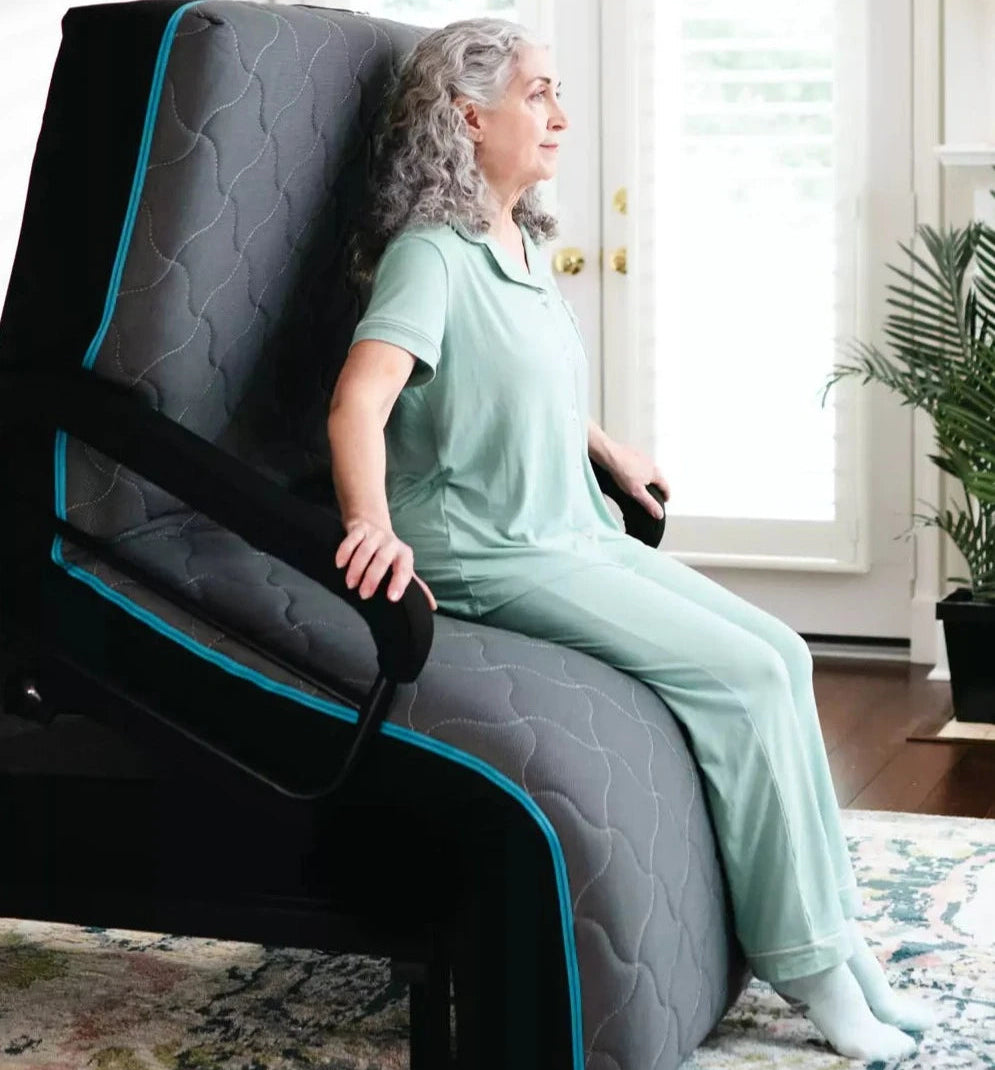
If getting in and out of bed stays hard, some families look at a sleep-to-stand bed such as the EzLift Deluxe. Think of it as furniture for lying down and getting up. It does not speed recovery or prevent falls. Ask your surgeon and physical therapist before you change the bed you will use after surgery.
FAQ
How long is knee replacement recovery for older adults?
MedlinePlus says full recovery from total knee replacement takes 4 months to a year. AAOS says most people can resume most normal daily activities within 3 to 6 weeks. AAOS bases the decision to operate on pain and disability, not age, so your overall health and the help you have at home matter too.
How long will I need a walker after knee replacement?
MedlinePlus says you may need a walker or crutches for up to 3 months. Your surgeon and physical therapist decide when you can move to a cane or stop using a walking aid.
When can I drive after knee replacement?
AAOS says most people resume driving about 4 to 6 weeks after surgery, once the knee bends enough to sit in the car and muscle control is good enough for braking. AAOS also says to wait until you no longer take opioid pain medicine. Your doctor makes the final call.
How long does swelling last after knee replacement?
AAOS says moderate to severe swelling is common in the first few days or weeks, and mild to moderate swelling can last about 3 to 6 months. Tell your doctor about new or severe swelling, because it can be a warning sign of a blood clot.
Is there an age limit for knee replacement?
AAOS says there are no absolute age or weight restrictions. Most people who have the surgery are 50 to 80 years old, and surgeons evaluate each person individually.
Sources
- American Academy of Orthopaedic Surgeons, OrthoInfo, Total Knee Replacement: https://orthoinfo.aaos.org/en/treatment/total-knee-replacement/
- American Academy of Orthopaedic Surgeons, OrthoInfo, Activities After Total Knee Replacement: https://orthoinfo.aaos.org/en/recovery/activities-after-knee-replacement/
- MedlinePlus Medical Encyclopedia, Knee joint replacement - discharge: https://medlineplus.gov/ency/patientinstructions/000170.htm
- MedlinePlus Medical Encyclopedia, Knee joint replacement: https://medlineplus.gov/ency/article/002974.htm
Written by the EzLift Team, EzLift's organizational authorship team. Last reviewed November 9, 2026. This guide summarizes AAOS OrthoInfo pages and MedlinePlus patient instructions. It is not medical advice and it does not replace the instructions from your surgeon or physical therapist. Recovery times differ by person and by surgery. This article does not claim that any bed, including an EzLift bed, treats a knee replacement, prevents falls, or speeds recovery.