



Sit-to-Stand Lift vs Hoyer Lift vs Sleep-to-Stand Bed: What's the Difference?
When a parent or spouse starts needing help getting up, families often run into three very different pieces of equipment: the sit-to-stand lift, the "Hoyer lift" and the sleep-to-stand bed. They can sound alike, but they are built for people with very different abilities. This guide explains what each one is, who clinical guidance says each type of lift is for, and where a sleep-to-stand bed fits and doesn't fit.
It is general information drawn from the U.S. Food and Drug Administration (FDA), the U.S. Department of Veterans Affairs (VA) safe patient handling program and MedlinePlus. It describes equipment categories, not specific products. Choosing transfer equipment depends on a person's strength, balance, ability to bear weight and ability to follow instructions. Ask a doctor, physical therapist or occupational therapist to assess the person before you choose or use a lift.
The short answer
- Sit-to-stand lift (stand assist lift): a mobile lift that helps raise a person from sitting to standing and lower them to another seat. VA guidance says the person must have some weight-bearing ability, some upper body strength, the ability to grasp with at least one hand and the ability to follow simple instructions.
- "Hoyer lift" (full-body sling lift): a lift that raises the person in a sling and moves them from one surface to another. VA guidance describes these lifts as designed for people who are dependent or need moderate to maximum assistance, including people who can't bear weight.
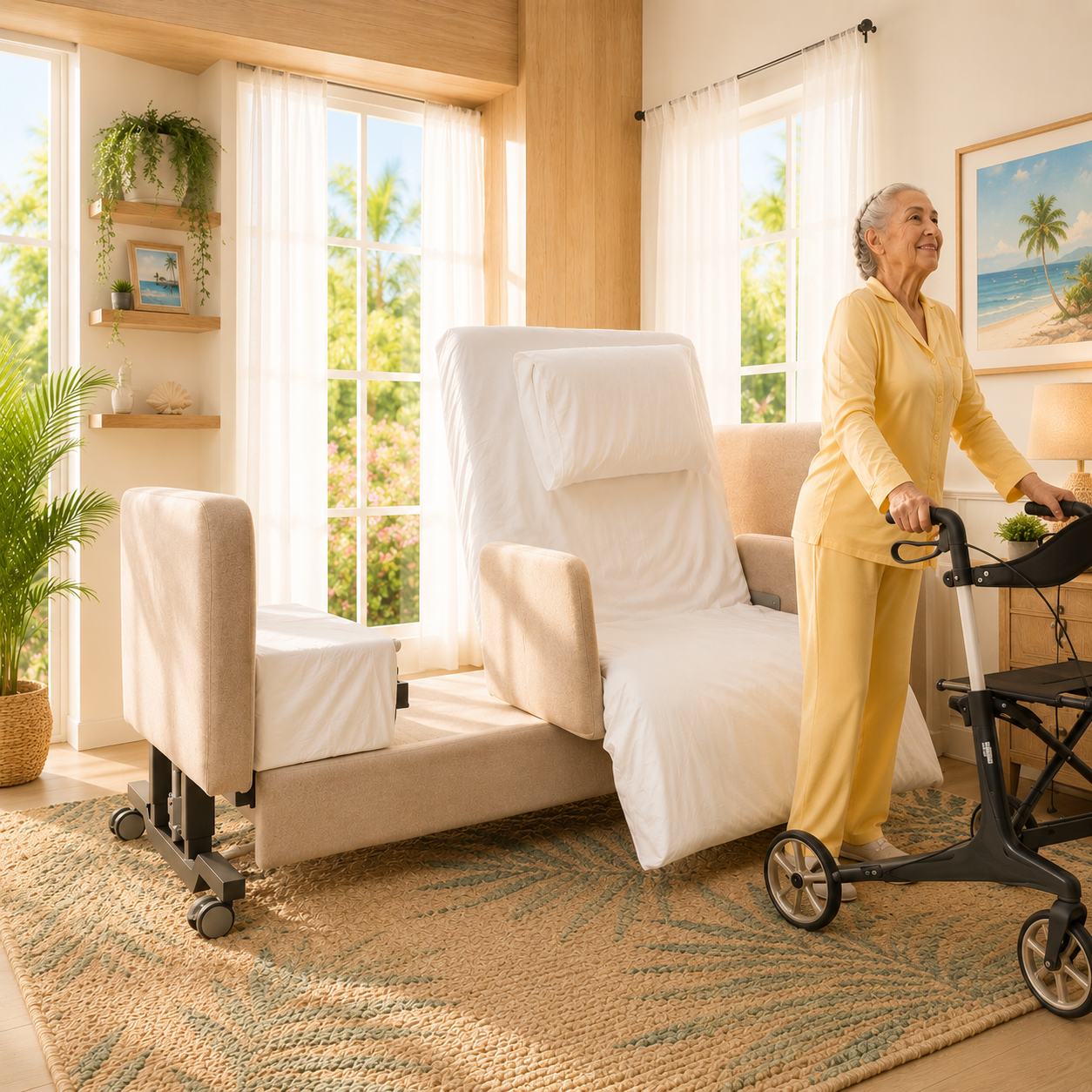
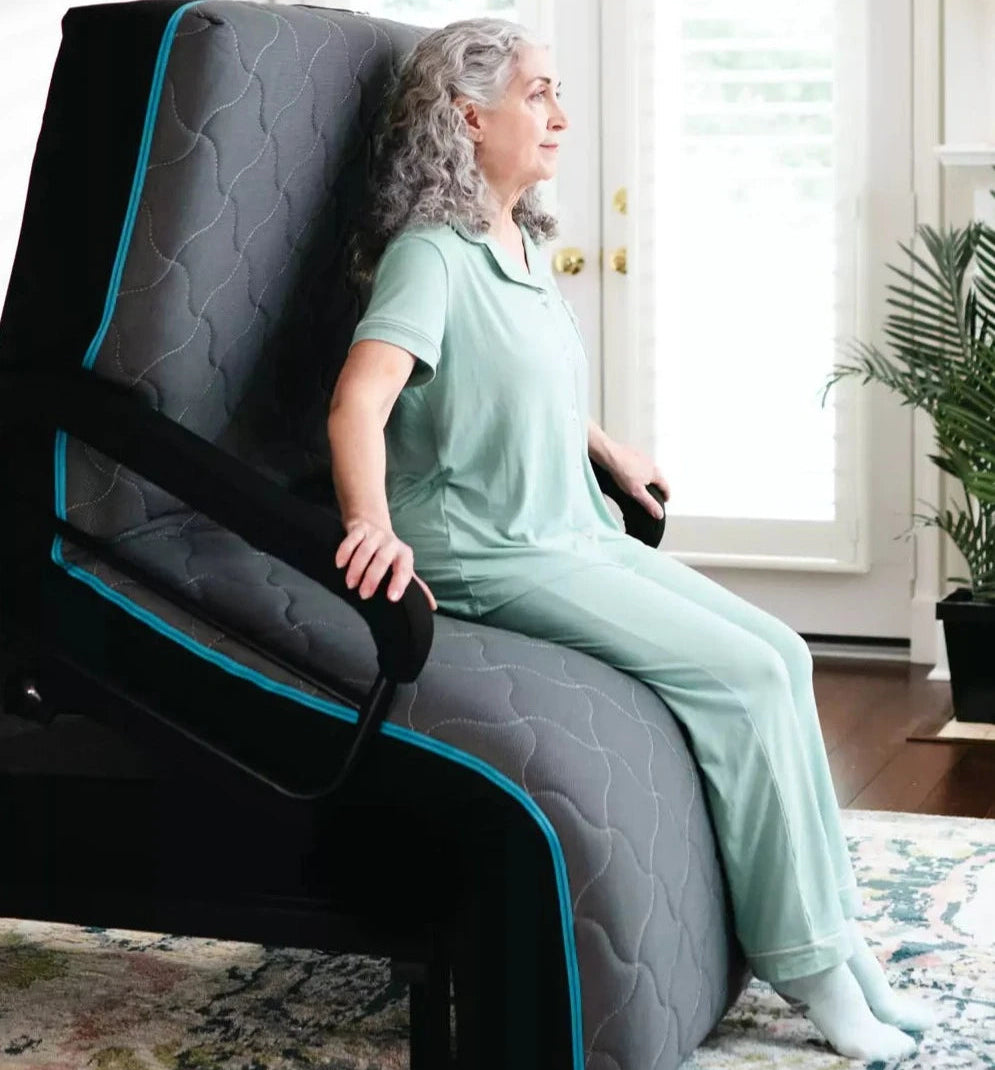
- Sleep-to-stand bed: a powered bed designed to move the user from lying down toward a standing position. It is a bed, not a patient lift. The person still stands on their own legs, so it does not replace a lift for someone who can't bear weight.
What is a sit-to-stand lift?
The VA's safe patient handling glossary defines a powered standing assist device, or sit-to-stand lift, as a powered device that raises and lowers a patient from or to a seated position using a sling that wraps around the back of the patient. The VA notes these lifts have many uses besides transfers, such as toileting, changing clothes and diapering. See the VA Safe Patient Handling and Mobility glossary (PDF).
To use one, the VA says the patient must have some upper body strength, cognitive ability, weight-bearing capability and the ability to grasp with at least one hand. The VA's 2021 Safe Patient Handling and Mobility Design Criteria add that sit-to-stand devices are specifically for patients who are partially dependent and require powered assistance, and that they can move a patient from one seated surface to another, such as bed, chair, wheelchair or commode. See the VA design criteria (PDF).
There are also non-powered versions. The VA glossary describes non-powered standing aids as supports patients use to lift themselves to a standing position and back down, which a caregiver then pushes to the destination; patients need some upper body strength, cognitive ability, weight-bearing capability, balance and the ability to grasp with at least one hand. The design criteria note that non-powered sit-to-stand lifts don't use protective slings, so they are used for higher-functioning patients.
What is a Hoyer lift?
Hoyer is a registered brand name of patient lift. In this guide, "Hoyer lift" refers to the general category that clinical guidance calls a full-body sling lift or floor-based lift.
The FDA explains that patient lifts are designed to lift and transfer patients from one place to another, such as from bed to bath or from chair to stretcher. They may be powered, generally with a rechargeable battery, or manual, operated with hydraulics. Basic parts may include a mast, a boom that extends over the patient, a spreader bar, a sling that holds the patient, and clips or latches that secure the sling. Read the FDA's patient lifts page.
The VA design criteria describe floor-based full-body sling lifts as designed for hoisting and transferring patients who are dependent or who require moderate to maximum or extensive assistance. A floor-based lift has a wheeled base that rolls on the floor; the lift motor raises or lowers the patient in a sling, but caregivers must manually push the lift and patient to the desired location, unless it is a motorized design. The VA glossary also describes overhead lifts, where the motor runs on a track or rail on the ceiling or wall, or on a free-standing gantry over the bed.
What is a sleep-to-stand bed?
A sleep-to-stand bed is a powered bed designed to move the user from lying down toward a standing position. Unlike a patient lift, it doesn't hold the person in a sling and doesn't carry them to another surface. Once the bed reaches its standing position, the person stands and walks on their own legs, with whatever walker, cane or helper they normally use.
Beds that do more than provide support are a recognized category in safe patient handling. The VA glossary lists "bed-assisted technology," beds with functions beyond support, including bringing patients to sitting positions. Our comparison of hospital beds, adjustable beds and sleep-to-stand beds explains how a sleep-to-stand bed differs from the other bed types.
A sleep-to-stand bed is not a substitute for a patient lift. If a person can't bear weight, or a clinician has said they need a full-body sling lift, a bed that helps them to a standing position doesn't change that.
How clinicians decide which one fits
The VA's safe patient handling algorithms, developed by the VA's Patient Safety Center in Tampa, guide caregivers through a few key questions for transfers such as bed to chair:
- Can the person bear weight fully, partially or not at all? If they can bear weight fully, the algorithm says caregiver assistance isn't needed, but a caregiver should stand by for safety.
- If they can bear weight partially, are they cooperative? If yes, the algorithm calls for a stand-and-pivot technique with a gait/transfer belt or a powered stand assist lift, with 1 caregiver. If not, it calls for a full-body sling lift and 2 caregivers.
- If they can't bear weight, the algorithm calls for a full-body sling lift and 2 to 3 caregivers, unless the person is cooperative and has upper body strength, in which case it calls for a seated transfer aid, such as a slide board.
The algorithms also set a simple limit: if a caregiver would have to lift more than 35 pounds of the person's weight, the person should be considered fully dependent and assistive devices should be used. See the VA Safe Patient Handling and Movement Algorithms (PDF, rev. 2006).
A later VA scoring guide from the Bay Pines VA puts it in similar terms: a powered sit-to-stand lift if the patient has some weight-bearing ability and is able to maintain balance, and for patients with minimal or no mobility, a seated or supine body sling and 2 to 3 healthcare workers. It also warns never to use gait belts to pull a patient to a vertical position. See the VA scoring and algorithms guide (PDF).
MedlinePlus, from the National Library of Medicine, draws the same line for home caregivers: its bed-to-wheelchair technique assumes the person can stand on at least one leg, and if the person can't use at least one leg, you will need to use a lift to transfer them. Read MedlinePlus: Moving a patient from bed to a wheelchair.
Side-by-side comparison
| Sit-to-stand lift | Full-body sling ("Hoyer") lift | Sleep-to-stand bed | |
|---|---|---|---|
| What it is | Mobile lift that raises a person from sitting to standing and lowers them to another seat | Lift that raises a person in a sling and moves them between surfaces | Powered bed that moves the user from lying down toward standing |
| Who guidance says it's for | People with some weight-bearing ability, upper body strength, grip in at least one hand, who can follow simple instructions (VA) | People who are dependent or need moderate to maximum assistance, including people who can't bear weight (VA) | Not a patient lift; the person stands on their own legs |
| Caregivers | VA algorithm: 1 caregiver for a cooperative person who can partially bear weight | VA algorithm: 2 to 3 caregivers; FDA: most lifts require two or more caregivers | Depends on the person; ask their clinician |
| Where it's used | Transfers between seats, toileting, changing clothes | Transfers between bed, chair, wheelchair, commode or bath; lifting from the floor | The bedroom, for getting into and out of bed |
Using a patient lift safely at home
The FDA says patient falls from lifts have resulted in severe injuries, including head traumas, fractures and deaths, and it has published best practices. Its patient lift safety guide and web page advise:
- Get training from a qualified medical professional before operating a patient lift at home, and keep the manufacturer's instructions close to your lift and always follow them.
- Make sure you have the required number of caregivers. The FDA says most lifts require two or more caregivers to operate safely, and never to operate a lift by yourself if the lift requires more than one person.
- Use only a sling designed for your lift. The FDA says a sling must be approved for use by the lift manufacturer and no sling is suitable for all patient lifts. Don't use a sling with signs of wear.
- Lock the wheels on any device that will receive the person, such as a wheelchair, bed or chair, and keep the lift's base legs in the maximum open position for stability.
- Don't exceed the weight limits for the lift and the sling.
- Make sure there is space for the lift to pivot and move, and that it can fit under or around the bed and through doorways. For thick carpet, the FDA suggests a lift with larger wheels or a plastic floor mat over the carpet.
- Never leave the person unattended in the lift, and never keep them suspended in the sling for more than a few minutes.
- If power fails, use the emergency release to lower the person, and have a back-up plan in case your lift stops working properly.
- Avoid using a patient lift if the person is agitated, resistant or combative.
See the FDA Patient Lifts Safety Guide (PDF).
Where a sleep-to-stand bed fits
If the person can stand and walk once they're up, but getting from lying down to standing is the hard part, the equipment question is different. Our guides to devices that help the elderly get out of bed and what to do if you physically can't get out of bed cover other options, such as bed canes and transfer poles. For people who can bear weight but have ongoing difficulty getting out of bed, a sleep-to-stand bed is one option some families consider.
EzLift sells sleep-to-stand beds; you can see the models on the EZLift Bed, EzLift Deluxe and Elevra Rotating Bed pages. A sleep-to-stand bed isn't a patient lift and isn't designed for someone who can't bear weight. If a clinician has recommended a sit-to-stand lift or a full-body sling lift, follow that recommendation, and ask whether any bed would fit the person's plan before you buy one.
If you are caring for someone at home, our article on why older adults fall out of bed and how to prevent it covers bedroom safety steps that apply whatever equipment you use.
Frequently asked questions
Is a Hoyer lift the same as a sit-to-stand lift?
No. A sit-to-stand lift helps a person who can partly bear weight rise from sitting to standing. A full-body sling lift (what this guide calls a Hoyer lift) lifts the person's whole body in a sling, and VA guidance uses it for people who are dependent, including those who can't bear weight.
Can one person operate a Hoyer lift at home?
Check the manufacturer's instructions and ask the clinician who trained you. The FDA says most lifts require two or more caregivers and that you should never operate a lift by yourself if it requires more than one person. The VA algorithms call for 2 to 3 caregivers with a full-body sling lift.
Can a sleep-to-stand bed replace a patient lift?
No. A sleep-to-stand bed helps move a person toward a standing position from the bed, but the person still has to stand on their own legs. For someone who can't bear weight, the VA algorithms generally call for a full-body sling lift (or, for some cooperative people with upper body strength, a seated transfer aid), and MedlinePlus says you will need a lift if the person can't use at least one leg.
Who decides which lift is right?
A doctor, physical therapist or occupational therapist who assesses the person's strength, balance, weight-bearing ability and cognition. The VA notes that ability can change with medical reasons, fatigue or medications, and that when in doubt, you should assume the person cannot assist with the transfer.
Sources
- U.S. Food and Drug Administration. Patient Lifts (content current as of August 22, 2018).
- U.S. Food and Drug Administration. Patient Lifts Safety Guide (PDF).
- U.S. Department of Veterans Affairs. Definitions and Glossary of Terms: Safe Patient Handling and Mobility (SPHM) (PDF).
- U.S. Department of Veterans Affairs. Safe Patient Handling and Mobility Design Criteria (PDF, August 1, 2021).
- VISN 8 Patient Safety Center, U.S. Department of Veterans Affairs, hosted by Oregon OSHA. Safe Patient Handling and Movement Algorithms (PDF, last rev. 8/23/06).
- Bay Pines VA Healthcare System, U.S. Department of Veterans Affairs. Scoring & Algorithms for Safe Patient Handling & Mobility (PDF, rev. September 8, 2011).
- MedlinePlus Medical Encyclopedia. Moving a patient from bed to a wheelchair (review date October 19, 2025).
Written by the EzLift Team, EzLift's organizational authorship team. Sources checked October 24, 2026. This guide offers general information; it is not medical advice. Ask a doctor, physical therapist or occupational therapist to assess the person and recommend transfer equipment, and follow the lift manufacturer's instructions.