




How to Transfer a Patient From Bed to a Chair or Commode Safely
Quick answer: For a person who can stand on at least one leg, MedlinePlus describes a pivot transfer: park the wheelchair beside the bed with the brakes on, help the person sit up and rest a moment, then stand and turn together. If they cannot use at least one leg, MedlinePlus says to use a lift instead.
First: is a manual transfer safe for this person?
Each source we read begins with the same question: how much can the person do? The MedlinePlus pivot turn assumes the person can stand on at least one leg. If they cannot stand, take small steps and carry part of their body weight, MedlinePlus says you should get help. If they cannot use at least one leg, it says you will need a lift. (MedlinePlus, Moving a patient from bed to a wheelchair)
A safe patient handling guide from the VA Bay Pines health care system, written for health care staff, sets a weight limit. If a caregiver would have to lift more than 35 pounds of the patient's weight, the guide says to treat the patient as fully dependent and use assistive devices. It also says to keep manual lifting to a minimum and to remove it where possible. (VA Bay Pines, Scoring and Algorithms for Safe Patient Handling and Mobility, revised 2011)
The VA guide scores each patient from 0 to 4 and matches the score to a method. The table shows its bed-to-chair algorithm in plain terms.
| VA score | The person | What the VA guide suggests |
|---|---|---|
| 0 | Is alert, oriented and walks on their own | No help needed. Stand by for safety. |
| 1 | Is cooperative and needs very little help | Cues and coaching. |
| 2 | Needs minimal help | Cues, coaching or light touch to stand and pivot, or a seated transfer aid such as a slide board or a chair with removable arms. A mechanical stand-assist aid if upper arm strength is adequate. Never use a gait belt to pull the person upright. |
| 3 | Needs moderate help | Always transfer toward the stronger side. A powered sit-to-stand lift if the person can bear some weight and keep their balance. Avoid lifting more than 35 pounds by hand. |
| 4 or more | Has little or no mobility, or is combative or confused | A seated or lying body sling with 2 to 3 health care workers. |
The guide adds that standing lifts should not be used if the patient is combative, unpredictable or has cognitive problems. An OpenStax nursing textbook says that for people who can bear some weight, nurses should use the stand-and-pivot method, preferably with a gait belt or a standing lift, and should transfer toward the stronger side. (OpenStax, Clinical Nursing Skills, 9.3 Transferring Patients)
Before you start
MedlinePlus says to think through the steps before you act and to get help if you need it. Its preparation list:
- Move loose rugs out of the way so no one slips.
- Put non-skid socks or shoes on the person if they will step onto a slippery floor.
- Tell the person what you are going to do.
- Place the wheelchair alongside the bed, parallel or at a slight angle.
- Lock the brakes and swing the footrests out of the way.
The OpenStax text adds some habits from nursing practice: ask permission, explain each step in simple words, gather the equipment first, ask the person to do as much as they can, and lock and steady the equipment before the move. It also says to ask for more help when you need it.
Step by step: the pivot turn from bed to wheelchair
These steps follow the MedlinePlus pivot turn. Read through all of them before you begin.
- Sit the person up. Roll them onto the side closest to the wheelchair. Put one arm under their shoulders and the other behind their knees, and bend your knees. Swing their feet over the edge of the bed and use that motion to bring them up to sitting.
- Pause. Let them sit for a few moments in case they feel dizzy after sitting up.
- Set their feet. Slide them to the edge of the bed. Lower the bed so their feet rest on the floor.
- Get a grip. Put a gait belt on them if you have one. Stand as close as you can, reach around the chest and lock your hands behind them, or hold the belt. They can hold onto you or reach for the wheelchair, but they should never hold you around the head or neck.
- Brace. Place their outside leg, the one farther from the wheelchair, between your knees. Bend your knees and keep your back straight.
- Stand together. Count out loud to three, then stand up slowly, using your legs and moving your weight from the front leg to the back leg. Meanwhile, the person puts their hands at their sides, pushes off the bed and helps carry their own weight.
- Pivot. Turn toward the wheelchair, moving your feet so your back stays lined up with your hips.
- Sit down. When their legs touch the seat, bend your knees and shift your weight forward to lower them. Ask them to reach for the armrest as they sit.
If the person starts to fall during the transfer, MedlinePlus says to lower them to the nearest flat surface: the bed, a chair or the floor. It also says to contact their health care provider if they fall.
Gait belts: useful, with limits
A gait belt is a strap a few inches wide, made of nylon, canvas or leather, that goes around the person's waist to give the helper something to hold. The OpenStax text says to put it snugly over a layer of clothing, with room for two fingers between the belt and the person, and to make sure the person wears nonslip footwear. It lists people who should not use one: those with abdominal aneurysms, feeding tubes in the stomach (G tubes), hernias, or severe heart or breathing conditions, and those who have had recent chest, back or abdominal surgery.
On one point the sources differ. MedlinePlus includes a gait belt in its one-person pivot. The VA guide, written for staff, says research indicates one caregiver should not use a gait belt for a standing transfer of a person who bears weight, and that gait belts should never be used to pull someone upright. It also says not to use them for people who are uncooperative or who have had a recent colostomy, ileostomy, or other abdominal or back surgery, among other conditions. In our view, ask a physical or occupational therapist to show you the method that fits your person before you rely on a belt.
Bed to commode
The VA guide uses one algorithm for bed to chair, chair to toilet and chair to chair moves. So the checks above apply to a bedside commode too: how much the person can help, whether they cooperate, and how much weight you would carry. For people who need moderate help, the guide mentions toileting slings. Our guide to drop-arm bedside commodes covers choosing a commode for bed-to-commode transfers.
Protect your own back
MedlinePlus tells the helper to bend the knees, keep the back straight and lift with the legs. The VA guide is frank about the limits of that advice: it says 35 years of research show that training in body mechanics alone does not prevent patient handling injuries in staff, and it says to keep manual lifting to a minimum. The OpenStax text says most facilities and lift makers require two caregivers to run a patient lift safely, and that lift wheels should be locked.
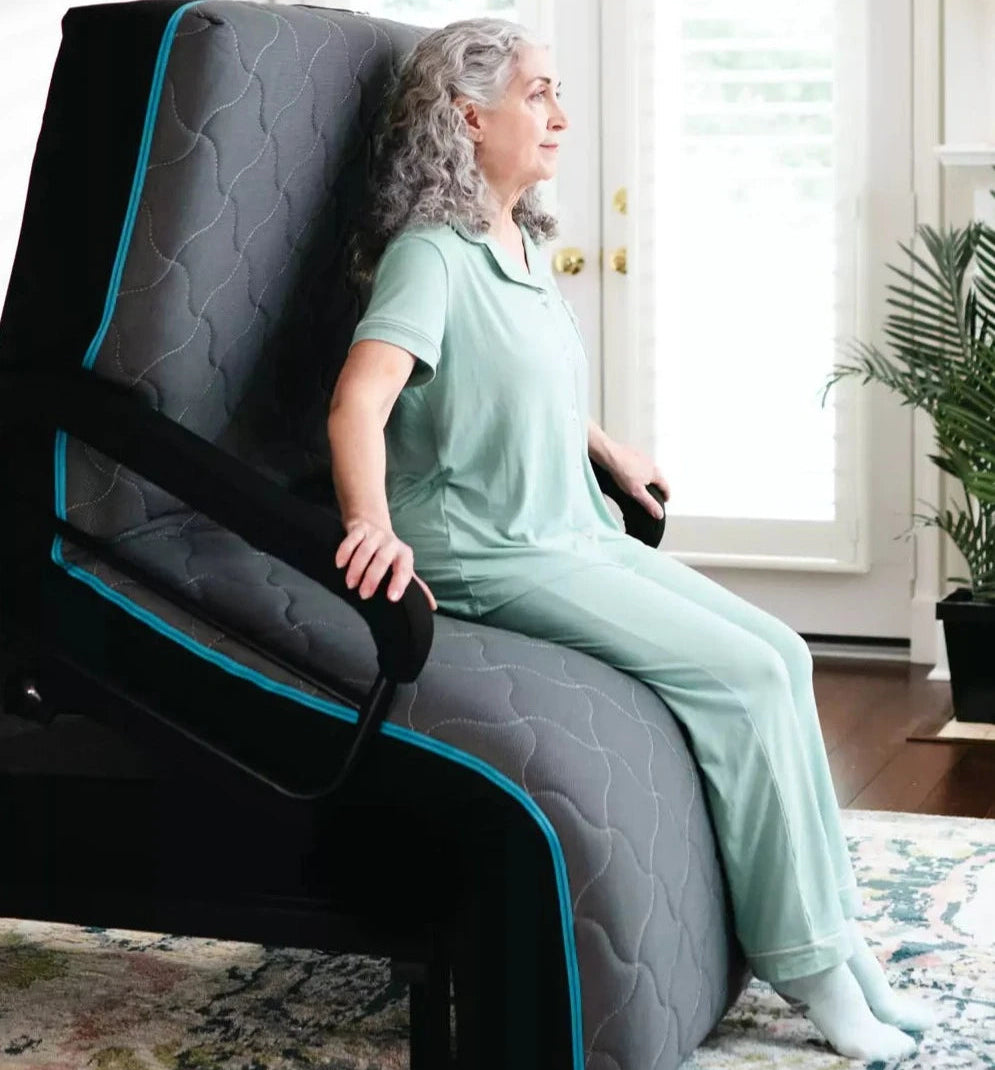
If transfers are getting harder, our guides to patient lifts for home use and sit-to-stand lifts, Hoyer lifts and sleep-to-stand beds compare the main options. For the first move out of bed, see transfer poles and bed handles and best bed height for seniors. EzLift sells lift beds for home use. Ask a physical or occupational therapist which equipment suits the person.
After a fall
The National Institute on Aging says to tell the doctor about any fall, even one without pain, because it can point to a new medical problem or to an issue with medicines or eyesight. From there, the doctor may suggest physical therapy, a walking aid or other ways to prevent future falls. (National Institute on Aging, Falls and Fractures in Older Adults)
FAQ
How do you transfer a patient from bed to chair by yourself?
MedlinePlus describes a one-person pivot turn, but only for someone who can stand on at least one leg and help support their own weight. If the person cannot stand, take small steps and support their body weight, it says to get help. If they cannot use at least one leg, it says to use a lift.
Should I use a gait belt for a bed to chair transfer?
MedlinePlus says a gait belt, if you have one, can help you grip during the turn. A VA safe patient handling guide for health care staff says research indicates one caregiver should not use a gait belt for a standing transfer of a person who bears weight, and that gait belts should never be used to pull a person up to standing. It also says not to use one for people who are uncooperative or who have had recent abdominal or back surgery, among other conditions. An OpenStax nursing textbook lists people who should not use a gait belt, including those with abdominal aneurysms, feeding tubes in the stomach (G tubes), hernias, severe heart or breathing conditions, or recent chest, back or abdominal surgery. The sources differ on one-caregiver use. Ask a therapist to show you the method that fits your person before you rely on a belt.
When do you need a patient lift instead of a manual transfer?
MedlinePlus says to use a lift when the person cannot use at least one leg. The VA guide says that if a caregiver would have to lift more than 35 pounds of the person's weight, the person should be treated as fully dependent and assistive devices should be used.
How do I move someone from a bed to a commode?
The VA guide uses one transfer algorithm for bed to chair, chair to toilet and chair to chair moves, so the same checks apply: how much the person can help, whether they cooperate, and how much weight you would have to lift. MedlinePlus says to park the wheelchair beside the bed with the brakes on, and the OpenStax text says to lock and steady equipment before a move. In our view, treat a commode the same way.
What should I do if the person starts to fall during a transfer?
MedlinePlus says to lower them to the nearest flat surface, such as the bed, a chair or the floor. It also says to contact the person's health care provider if they fall.
Sources
- MedlinePlus Medical Encyclopedia, Moving a patient from bed to a wheelchair (review date October 19, 2025): https://medlineplus.gov/ency/patientinstructions/000428.htm
- VA Bay Pines Health Care System, Scoring and Algorithms for Safe Patient Handling and Mobility (revised September 8, 2011): https://mobile.va.gov/sites/default/files/SPH_Scoring_and_Algorithms.pdf
- OpenStax, Clinical Nursing Skills, 9.3 Transferring Patients (Rice University): https://openstax.org/books/clinical-nursing-skills/pages/9-3-transferring-patients
- National Institute on Aging, Falls and Fractures in Older Adults: Causes and Prevention (content reviewed September 12, 2022): https://www.nia.nih.gov/health/falls-and-falls-prevention/falls-and-fractures-older-adults-causes-and-prevention
Written by the EzLift Team, EzLift's organizational authorship team. Last reviewed November 15, 2026. This guide summarizes MedlinePlus, a VA safe patient handling guide, an OpenStax nursing textbook and a National Institute on Aging page. It is not medical advice. Ask a physical therapist, occupational therapist or nurse to show you how to transfer the person before you try it on your own, and call the doctor after any fall.