




Bed Bumpers and Floor Mats for Adults: Do They Help With Falls From Bed?
Quick answer: Adult bed bumpers (foam pads along the mattress edge) and bedside floor mats do not stop someone from rolling or climbing out of bed. What the evidence supports is more modest. The FDA lists foam bumpers as one alternative when adult portable bed rails are not appropriate. AHRQ's falls program lists a floor mat as one way to reduce injury risk if a fall happens, next to a low bed. Lab studies of simulated falls from bed show mats cut injury risk to the head and pelvis compared with a hard floor. Use mats only while the person is in bed, and remove them before standing or transferring so the mat does not become a trip hazard.
Why people look at bumpers and mats
Caregivers ask about falls from bed a lot. Our guide to why older adults fall out of bed covers the common causes. When rails feel unsafe, families often search for bed bumpers for adults or a floor mat for falling out of bed. Those products are not the same job. Bumpers sit on the mattress. Mats sit on the floor.
AHRQ's patient-safety primer on falls says fall prevention measures must be individualized. There is no "one size fits all" method. A successful plan combines several strategies, including environmental changes and, when useful, lowering the bed height. (AHRQ PSNet, Falls)
What the FDA says about foam bumpers vs bed rails
Adult portable bed rails can entrap or injure people. The FDA and CPSC have received death and injury reports related to these products, mostly for entrapment, asphyxiation and falls. (FDA, Safety Concerns about Adult Portable Bed Rails) The FDA says adult portable bed rails should not be used as a restraint. They are meant to help with mobility for people who need help getting in and out of bed or repositioning.
Some people are at high risk for entrapment, falls or other injury from adult portable bed rails. That list includes people with confusion, restlessness, lack of muscle control, Alzheimer's or dementia, Parkinson's disease, multiple sclerosis, balance disorders, stroke or low blood pressure. (FDA, Recommendations for Consumers and Caregivers)
When bed rails are not appropriate, the FDA says to consider other alternatives. Those alternatives include "roll guards, foam bumpers, lowering the bed as near to the floor as possible, using concave mattresses that can help reduce rolling off the bed, or a bed trapeze to help reposition while in bed and to get in and out of bed." The FDA also says adult portable bed rails should not be used as a substitute for proper monitoring, especially for people at high risk for entrapment and falls. (FDA, Recommendations for Consumers and Caregivers)
Foam bumpers are on that FDA alternatives list. That is not the same as a claim that bumpers prevent falls. For the rail-specific safety rules, see our guide to bed rails for elderly adults.
Do floor mats help with falls from bed?
A floor mat softens the landing if someone leaves the bed. It does not keep them in it. AHRQ's Falls Management Program sample interventions plan lists "Floor mat" under "Reduce risk of injury," next to "Low bed," hip protectors and "Lower or remove side rails." (AHRQ, Appendix C8 Fall Interventions Plan Sample)
Two rehabilitation-nursing biomechanics studies tested simulated falls from bed onto mats versus a hard floor:
- Raymond, Catena and Vaughan (2011) dropped a side-impact dummy from 45.7 cm, 61.0 cm and 76.2 cm onto two types of protective floor mats and onto an unpadded rigid floor. Falls onto an unpadded rigid floor at 61.0 cm and 76.2 cm showed a high risk (greater than 50%) for serious head injury. Falls onto floor mats showed significant reductions in injury risk to the head and pelvis at all drop heights. Thoracic injury risk was significantly reduced for all but the highest drop height. (PubMed 22073504)
- Bowers, Lloyd, Lee, Powell-Cope and Baptiste (2008) calculated injury criteria for head-first and feet-first falls from several bed heights onto tile and onto a floor mat. Using a floor mat decreased the predicted risk of serious head injury to less than 1% for feet-first falls at bedrail height, compared with about 40% when the height added by bedrails was included for falls onto tile. The authors concluded that floor mats and height-adjustable beds set to the lowest height should be used to decrease the risk of injury associated with falling from bed. (PubMed 19024240)
Those are lab studies with test dummies, not clinical trials in living patients. They support injury reduction if a fall happens. They do not show that a mat keeps a person in bed.
How to use a bedside floor mat safely
The VA National Center for Patient Safety's Floor Mat Resource and Implementation Guide says floor mats are pads placed on the floor at the bedside. It lists selection criteria that include impact attenuation, stability, friction, thickness, weight and overall size. It advises using mats with beveled edges to reduce tripping risk, and says thicker mats raise the trip risk. (VA Floor Mat Resource and Implementation Guide)
On appropriate use, the VA guide says to stow the floor mat safely when the patient is standing and ambulating. If the patient is going to stand or transfer with assistance, the floor mat is to be removed and secured. Leave the mat in place only while the person is in bed.
| Product | Where it sits | What sources support | Main limit |
|---|---|---|---|
| Foam bed bumper / roll guard | On or along the mattress edge | FDA lists foam bumpers and roll guards as alternatives when portable bed rails are not appropriate | Not a fall-prevention claim; does not replace monitoring |
| Bedside floor mat | On the floor next to the bed | AHRQ lists mats under injury-risk reduction; lab studies show lower head/pelvis injury risk vs hard floor | Trip hazard if left out during standing or transfers; remove first |
| Low bed height | Whole bed closer to the floor | FDA alternative; AHRQ injury-reduction list; Bowers et al. recommend lowest height | Still need a safe way to get in and out of bed |
| Adult portable bed rail | Attached to the bed/mattress | Assistive use only for some people; FDA/CPSC death and injury reports for entrapment and falls | High-risk people should not use; not a restraint; see FDA guidance |
What this means at home
If falls from bed are already happening, start with a clinician or occupational therapist. Ask whether rails are appropriate at all. If they are not, the FDA's alternatives list (foam bumpers, lowest safe bed height, concave mattress, trapeze) is a better starting point than buying a rail. If you add a floor mat, pick one with beveled edges, keep it only while the person is in bed, and clear it before every transfer.
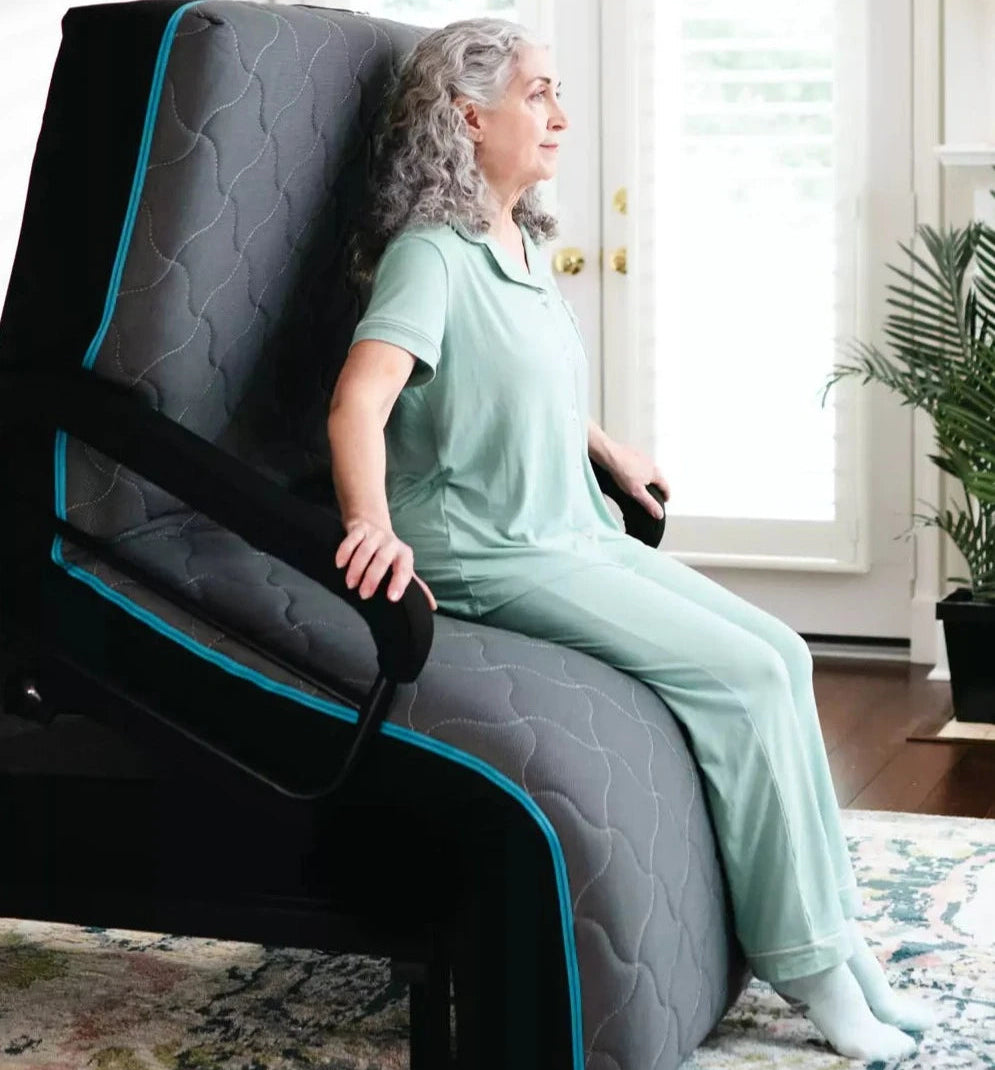
EzLift sells sleep-to-stand and rotating lift beds. This article does not claim those beds prevent falls. For bed height measurement, see best bed height for seniors. For types of lift beds, see our adjustable lift beds collection.
FAQ
Do bed bumpers for adults prevent falls from bed?
No reliable source says foam bumpers prevent falls. The FDA lists foam bumpers as an alternative when adult portable bed rails are not appropriate. That is a different claim from fall prevention.
Do floor mats stop someone from falling out of bed?
No. Floor mats are meant to reduce injury if a fall onto the floor happens. Lab studies show lower head and pelvis injury risk on mats than on a hard floor. They do not keep a person in bed.
When should I remove a bedside floor mat?
The VA floor-mat guide says to remove and secure the mat before the person stands or transfers, and to stow it when the person is ambulating. Leave it out only while the person is in bed.
Are bed rails safer than bumpers?
Not for everyone. The FDA warns that adult portable bed rails can entrap or injure high-risk people, and that they should not be used as a restraint. Read the FDA consumer recommendations and our bed-rails safety guide before choosing rails.
Sources
- FDA, "Recommendations for Consumers and Caregivers about Adult Portable Bed Rails" (content verified 2026-11-06 on relocated FDA path adult-portable-bed-rail-safety; box copy from 2026-10-21 matched): https://www.fda.gov/medical-devices/adult-portable-bed-rail-safety/recommendations-consumers-and-caregivers-about-adult-portable-bed-rails
- FDA, "Safety Concerns about Adult Portable Bed Rails" (content current as of 02/27/2023; same note): https://www.fda.gov/medical-devices/adult-portable-bed-rail-safety/safety-concerns-about-adult-portable-bed-rails
- AHRQ PSNet, "Falls" primer: https://psnet.ahrq.gov/primer/falls
- AHRQ, "Appendix C8: Fall Interventions Plan Sample," Falls Management Program (content last reviewed December 2017): https://www.ahrq.gov/patient-safety/settings/long-term-care/resource/injuries/fallspx/apcfigtxt8.html
- Raymond DE, Catena RD, Vaughan KT. "Biomechanics and injury risk assessment of falls onto protective floor mats." Rehabil Nurs. 2011. PMID 22073504: https://pubmed.ncbi.nlm.nih.gov/22073504/
- Bowers B, Lloyd J, Lee W, Powell-Cope G, Baptiste A. "Biomechanical evaluation of injury severity associated with patient falls from bed." Rehabil Nurs. 2008. PMID 19024240: https://pubmed.ncbi.nlm.nih.gov/19024240/
- VA National Center for Patient Safety, "Floor Mat Resource and Implementation Guide" (4/21/14): https://www.patientsafety.va.gov/docs/fallstoolkit14/floor_mat_guide_042114v2.pdf
Written by the EzLift Team, EzLift's organizational authorship team. Last reviewed November 6, 2026. This guide summarizes FDA, AHRQ, VA and published biomechanics guidance; it is not medical advice. EzLift beds are not claimed to prevent falls. Follow your clinician's advice and the product maker's instructions for any bumper, mat or rail.