




Best Bed and Sleeping Position After Back Surgery or Spinal Fusion
Quick answer: The spine guides we read do not ask for a special bed. Aurora Health Care says a hospital bed will not be necessary. It asks for a firm mattress and a bed height that lets your feet reach the floor. Sleep on your back with a pillow under your knees, or on your side with one between them.
Do you need a special bed after back surgery?
Going by the hospital guides we read, usually not. Aurora Health Care's lumbar fusion and laminectomy packet has a page on preparing your home. For the bedroom, it says to make sure your mattress is firm and your bed is easy to get to. The bed should be high enough that your feet reach the floor with your hips bent less than 90 degrees. It says a hospital bed will not be necessary, but suggests moving a bed to the first floor if your bedroom is upstairs. (Aurora Health Care, Lumbar Fusion/Laminectomy packet)
Two other guides ask you to measure before surgery. NorthShore's spine surgery guide asks you to tell your therapist the approximate height of your bed, so you can practice bed moves at a height like the one at home. (NorthShore, Spine Surgery Patient Guide) Palomar Health's pre-surgery checklist has a blank for your bed height in inches. (Palomar Health, Spine Surgery patient guide)
MedlinePlus gives the simplest rule for sleep: sleep in any position that does not cause back pain. (MedlinePlus, Spine surgery: discharge) Our take: measure your bed now, while bending is still easy. For how to measure, see best bed height for seniors.
Sleeping positions after spinal fusion
| Position | Pillow set-up | Which guides say so |
|---|---|---|
| On your back | One pillow under your knees. A small pillow under your head so your head and neck do not push forward, or a pillow with neck support | Aurora, NorthShore, Palomar, Sky Lakes |
| On your side | A pillow between your knees and one under your head so your neck is straight. Pillows in front of your body can support the top arm and stop you twisting; pillows behind you can hold you on your side | Aurora, NorthShore, Palomar, Sky Lakes |
| Any position | Any position that does not cause back pain | MedlinePlus |
Sky Lakes Medical Center's guide adds neck and waist support as needed when you lie on your side. (Sky Lakes Medical Center, Spine Surgery Guide: Activity After Surgery) Aurora's precautions sheet says the pillow between your knees is for comfort and can help you keep to your precautions, which include not crossing your knees or ankles while sitting, standing or lying.
How to log roll out of bed
Sky Lakes says the purpose of the log roll is to avoid twisting your spine and protect your surgery. Aurora's precautions sheet says to always log roll out of bed. Palomar Health's guide breaks it into five steps:
- Lie flat on your back and bend both knees, with your feet flat on the bed.
- Tighten your stomach muscles and roll onto your side toward the edge of the bed in one motion.
- Slowly lower your legs off the edge while you steady your upper body with your elbow and opposite hand.
- Push yourself up to sitting, keeping your shoulders, hips and knees in line.
- From sitting, stand up. Use the same steps in reverse to lie down.
To get into bed, Sky Lakes says to sit on the side of the bed, lower yourself with your arms for support, and bring your legs up onto the bed in one motion, without twisting. Aurora's packet puts it plainly: bend both knees and roll, moving your knees, hips and shoulders together.
In the hospital, don't try this alone at first. NorthShore asks patients not to get out of bed on their own after spine surgery because there is a greater risk of falling, and Sky Lakes says to call for help whenever you get out of bed.
Precautions that shape your bed set-up
Aurora's lumbar precautions sheet lists five rules. Four of them are: do not bend forward at the waist more than 90 degrees or raise your knees higher than your hips; do not lift more than 10 pounds; do not twist your trunk; and do not cross your knees or ankles. MedlinePlus gives a similar lifting limit of around 10 pounds, about a gallon of milk, and says to bend your knees and squat rather than bend at the waist.
In our reading, those rules fit the bed height advice. If the bed is so low that your knees end up above your hips, standing up breaks the first rule. NorthShore also says you should not use step stools or ladders after discharge, so it suggests moving things in cabinets and drawers to where you can reach them easily, not too high and not too low.
If your surgeon fitted a brace, MedlinePlus says you do not need to wear it when sitting on the side of the bed for a short time or using the bathroom at night. Follow your own surgeon's brace instructions first.
Recliner or bed after back surgery?
On sitting, the guides are clear. Palomar Health says not to sit on low surfaces or soft seats, to keep your hips no lower than your knees, and to avoid recliners, rocking chairs and low stools. It recommends a tall-back chair with armrests when possible. NorthShore says to support your spine with a pillow against the back of the chair, keep your feet on the floor, and change positions through the day.
How long you sit at one time is a question for your surgeon. MedlinePlus, in its discharge advice, says to try not to sit for longer than 20 or 30 minutes at one time. Sky Lakes gives 45 minutes in its hospital activity section, for sitting in a chair while you are still in the hospital. Use the number your own surgeon gives you.
None of the guides we read covers sleeping in a recliner. If you are thinking about it, ask your surgeon before you go home.
Where a lift bed fits
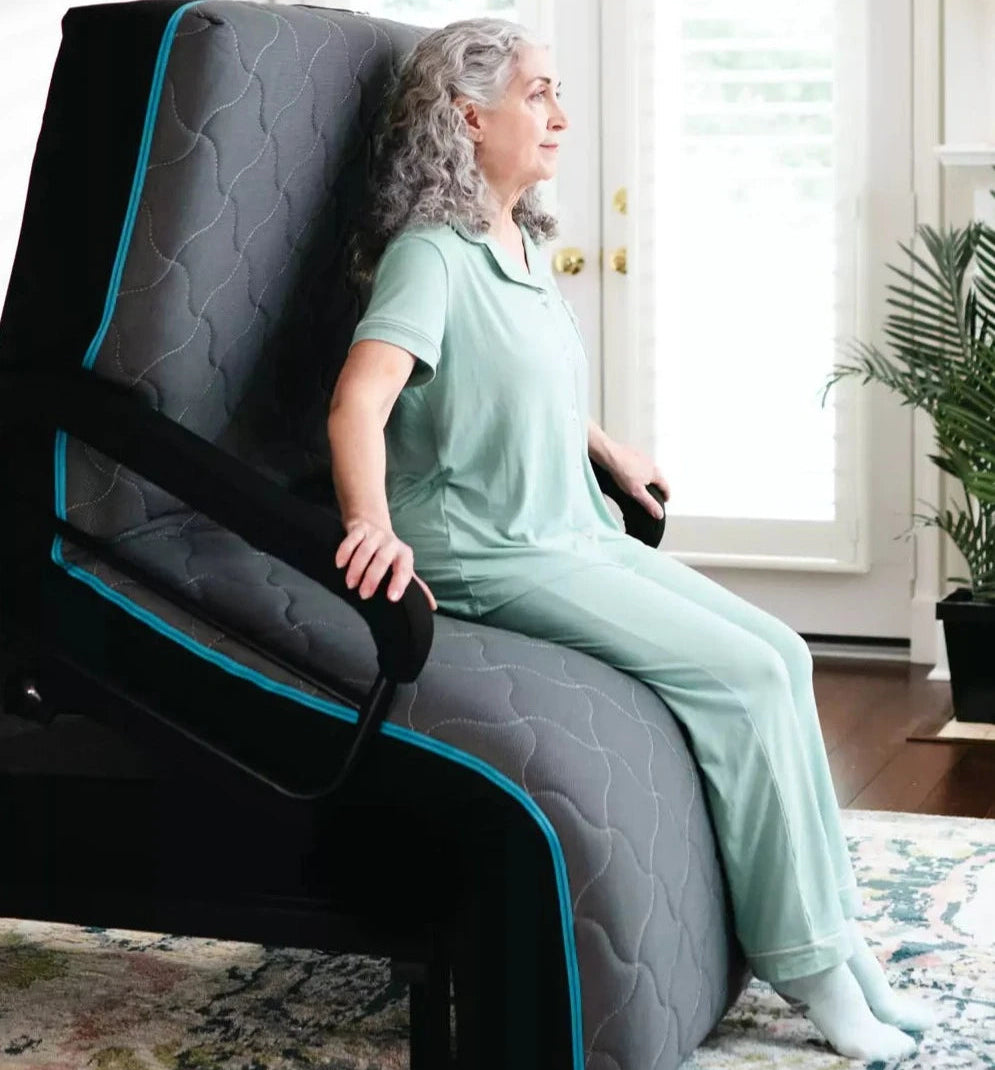
Aurora's guide says a hospital bed will not be necessary, so the first things to check are your mattress and your bed height. Some families still look at a powered bed for longer-term needs. EzLift sells lift beds for home use. We do not claim that any bed speeds recovery from spine surgery or prevents falls. If you are comparing types, see our guide to hospital, adjustable and sleep-to-stand beds. If you need a walker for balance after surgery, as Sky Lakes says some patients do, our walker vs cane guide may help.
MedlinePlus describes spinal fusion as surgery to permanently join two or more bones in the spine so there is no movement between them. (MedlinePlus, Spinal fusion) Palomar Health says to keep following your spinal precautions as your doctor orders.
FAQ
What is the best bed after back surgery?
The hospital guides we read do not name a type of bed. Aurora Health Care's lumbar fusion packet says a hospital bed will not be necessary. It asks for a firm mattress and a bed height that lets your feet reach the floor with your hips bent less than 90 degrees. Follow your own surgeon's advice if it differs.
What is the best sleeping position after spinal fusion?
The guides agree on two positions. On your back, put a pillow under your knees. On your side, put a pillow between your knees and one under your head so your neck stays straight. MedlinePlus says to sleep in any position that does not cause back pain.
How do I get out of bed after back surgery?
Use the log roll your therapist teaches. Palomar Health's steps are: lie on your back with knees bent, tighten your stomach and roll onto your side in one motion, lower your legs off the bed while you brace with your elbow and other hand, then push up to sitting with shoulders, hips and knees in line.
Can I sit in a recliner after back surgery?
Palomar Health's spine guide lists recliners, rocking chairs and low stools among seats to avoid, and suggests a tall-back chair with armrests. It also says not to sit on low or soft seats. The guides we read do not address sleeping in a recliner, so ask your surgeon.
How long can I sit at one time after spine surgery?
It depends on your surgeon. MedlinePlus, in its discharge advice, says to try not to sit for longer than 20 or 30 minutes at one time. Sky Lakes Medical Center gives 45 minutes in its hospital activity section, for sitting in a chair while you are still in the hospital. Use whichever limit your own surgeon gives you.
Sources
- Aurora Health Care, Lumbar Fusion/Laminectomy patient packet (precautions sheet 2016; home safety sheet revised 2013): https://ahc.aurorahealthcare.org/fywb/x46851.pdf
- NorthShore University HealthSystem, Spine Surgery Patient Guide: https://www.northshore.org/globalassets/spine-center/spinesurgery_patientguide.pdf
- Palomar Health, Spine Surgery patient guide (July 2025): https://www.palomarucsdhealth.org/wp-content/uploads/2025/07/23631_SPINE-Patient-Guide-Edits-July-2025_compressed.pdf
- Sky Lakes Medical Center, Spine Surgery Guide: Activity After Surgery: https://www.skylakes.org/wp-content/uploads/2024/07/SpineActivityAfter.pdf
- MedlinePlus, Spine surgery: discharge: https://medlineplus.gov/ency/patientinstructions/000313.htm
- MedlinePlus, Spinal fusion: https://medlineplus.gov/ency/article/002968.htm
Written by the EzLift Team, EzLift's organizational authorship team. Last reviewed November 12, 2026. This guide summarizes hospital patient guides from Aurora Health Care, NorthShore, Palomar Health and Sky Lakes Medical Center, and MedlinePlus. It is not medical advice. Precautions differ by surgery and surgeon, so follow your own surgeon, physical therapist and occupational therapist. This article does not claim that any bed or EzLift product speeds recovery, prevents falls, prevents injury or treats any condition.