




Alternating Pressure Mattresses for Hospital Beds: How They Work
Quick answer: An alternating pressure mattress uses an air pump to inflate and deflate rows of air cells in turn, so the pressure on any one spot of the body keeps changing. It comes as an overlay on top of an existing mattress or as a full replacement mattress. It does not replace regular repositioning and skin checks.
How an alternating pressure mattress works
CMS, which writes Medicare's equipment rules, gives the clearest technical definition we found. Its Group 1 policy article says powered overlays (alternating pressure or low air loss) have an air pump or blower that provides either sequential inflation and deflation of air cells or a low interface pressure throughout the overlay. The air cells must be 2.5 inches or greater when inflated. The height and spacing of the chambers, the frequency of air cycling and the air pressure must give enough lift to reduce pressure and prevent bottoming out. (CMS, Pressure Reducing Support Surfaces Group 1 Policy Article A52489)
In plain terms, some cells deflate while others hold you up, and then they swap. And it keeps cycling as long as the pump runs.
Overlay or full mattress?
Most families hit this choice first. CMS draws the line clearly.
| Type | CMS code | Air cell height | Where it goes |
|---|---|---|---|
| Alternating pressure overlay (pad with pump) | E0181 | 2.5 inches or greater | On top of an existing mattress |
| Powered pressure reducing mattress (alternating pressure or low air loss) | E0277 | 5 inches or greater | Directly on a hospital bed frame |
Sources: CMS A52489; CMS, Pressure Reducing Support Surfaces Group 2 Policy Article A52490.
The Group 2 article adds that a powered mattress must have a surface designed to reduce friction and shear. It also explains how mixed products are classed: by the topmost layer. Its own example is a product with 3 inch powered air cells on top of a 3 inch foam base, which counts as a powered overlay, not a powered mattress.
This matters when you shop. Something sold as a "mattress" may be coded, and covered, as an overlay.
What the research says
The best summary we found is a 2021 Cochrane review led by Chunhu Shi that compared foam surfaces with other support surfaces for preventing pressure ulcers. It included 29 studies with 9566 participants, mainly from acute care settings. The median of the studies' average participant ages was 76. (Cochrane Database of Systematic Reviews, Foam surfaces for preventing pressure ulcers, 2021)
For alternating pressure air surfaces, the authors concluded that foam surfaces may increase pressure ulcer incidence compared with them. In the pooled result from 4 studies, 10.4% of people on foam developed new pressure ulcers, compared with 7.4% on alternating pressure air surfaces. The authors rated that evidence low certainty, and the range of the result includes no difference. They also concluded, from one study, that alternating pressure air surfaces are probably more cost-effective than foam in preventing new pressure ulcers.
We'd still be careful: the comparison comes mostly from hospitals, and it is not strong enough to call any mattress a guarantee.
A mattress is only part of the plan
MedlinePlus lists what people at risk of pressure injuries and their caregivers should do in bed. It says to change position every 1 to 2 hours, to check the body every day from head to toe, and to never drag yourself to change position or get in or out of bed. It also says not to put pillows under the knees, because that puts pressure on the heels. (MedlinePlus, Preventing pressure ulcers)
Medicare's own Group 2 rules point the same way. They expect a care plan that includes turning and positioning, wound care, moisture and incontinence management, and a nutrition assessment, with regular checks by a nurse or other licensed practitioner. (CMS, LCD L33642 Pressure Reducing Support Surfaces Group 2)
If a pressure injury is already there, let the care team choose the surface. Picking one off a shopping site and hoping is not a plan.
The bottoming-out hand check
An air surface that is too soft lets the body sink through to the frame. CMS calls this bottoming out. Its Group 1 policy describes the check: with an outstretched hand placed palm up under the overlay or mattress, below the person's bony prominence (the tailbone or the side of the hip), you can readily feel the bone. CMS says to test it with the person lying flat on the back, on the back with the head raised no more than 30 degrees, and lying on the side. (CMS, LCD L33830 Pressure Reducing Support Surfaces Group 1) If you can feel the bone, call the supplier or nurse.
Medicare coverage
Medicare.gov says Part B covers medically necessary durable medical equipment ordered for use in your home, and that you pay 20% of the Medicare-approved amount after the Part B deductible if the supplier accepts assignment. (Medicare.gov, Hospital beds) For support surfaces, two CMS policies set the criteria:
- Group 1 (LCD L33830) covers overlays and mattresses including E0181 if the person is completely immobile, or has limited mobility or any stage pressure ulcer on the trunk or pelvis plus at least one of: impaired nutritional status, fecal or urinary incontinence, altered sensory perception, or compromised circulatory status.
- Group 2 (LCD L33642) covers surfaces including E0277 if the person has multiple stage 2 pressure ulcers on the trunk or pelvis that have failed to improve over the past month on a full treatment program including a Group 1 surface; large or multiple stage 3 or 4 ulcers on the trunk or pelvis; or a recent flap or skin graft for a pressure ulcer, with the conditions the LCD sets.
The CMS Master List shows prior authorization is required for E0277, with an effective date of 07/22/2019. (CMS Master List, E0277) Ask your doctor and a Medicare-enrolled supplier which code fits and what paperwork they need.
EzLift is not a Medicare-enrolled supplier. EzLift beds are not billed to Medicare, Medicaid or insurance. For the bed side of coverage, see does Medicare cover beds.
Fit, rails and entrapment
Air surfaces change the gaps around a bed. That is easy to miss. An FDA guide on reducing entrapment risk says air and water mattresses may pose unique issues if the mattress edges collapse under the weight of a person, pushing them into the rail. That can raise the risk of entrapment in or around the rail, or of suffocation if the face is pushed against a mattress without air flow. (FDA, A Guide for Modifying Bed Systems and Using Accessories to Reduce the Risk of Entrapment)
The same guide says FDA recommends using a mattress overlay on a bed system that meets its dimensional limits, and checking with the manufacturer about which bed frame is most compatible. It says the clinical benefit of a pressure reduction product should outweigh the entrapment risk, and that mattress length, width, depth and compressibility all affect the gaps.
Because the pump runs on electricity, plan for outages too. Our power outage plan for powered beds covers that. For non-powered options, see hospital bed mattress toppers, and for rail safety, bed rails for elderly adults. Our guide to hospital bed positions covers head-of-bed settings.
Hospital beds and home lift beds
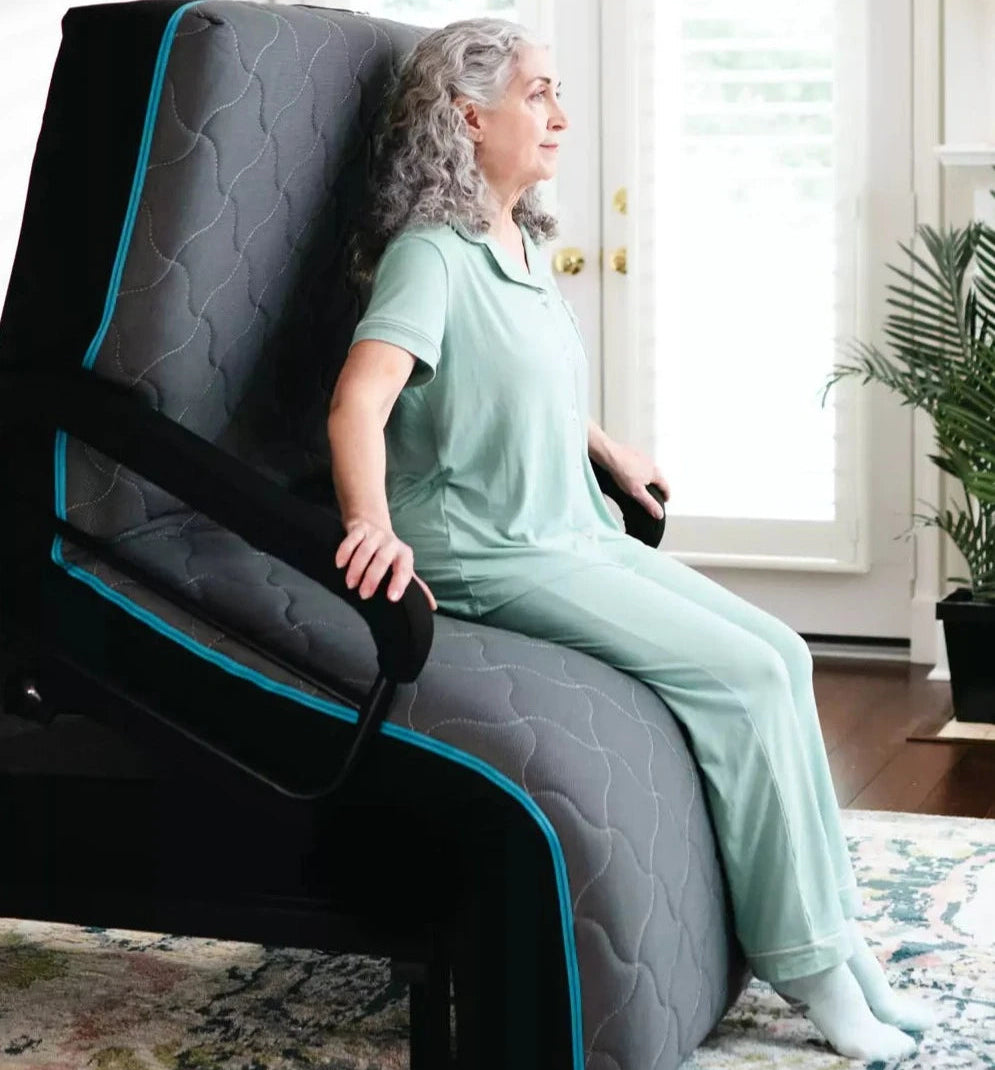
Full replacement air mattresses (E0277) are made for hospital bed frames. Overlays sit on top of an existing mattress. EzLift sells lift beds for home use, which are not hospital beds, and we do not claim any air overlay fits them. If a care team has asked for a pressure-reducing surface, follow their plan and the supplier's fit instructions. Our guide to hospital beds for home use covers the frames these mattresses are made for.
FAQ
What is an alternating pressure mattress?
It is a powered air surface. CMS policy articles describe an air pump or blower that provides sequential inflation and deflation of the air cells. As cells take turns filling and emptying, the points of pressure on the body keep changing.
What is the difference between an alternating pressure overlay and a mattress?
An overlay sits on top of an existing mattress. CMS codes alternating pressure overlays as E0181 and requires air cells of 2.5 inches or greater. A full alternating pressure mattress, code E0277, needs air cells of 5 inches or greater and can be placed directly on a hospital bed frame.
Do alternating pressure mattresses prevent bed sores?
No mattress can promise that. A 2021 Cochrane review found that foam surfaces may increase pressure ulcer incidence compared with alternating pressure air surfaces, but the evidence was low certainty. MedlinePlus still advises changing position every 1 to 2 hours and checking the skin every day.
Does Medicare cover an alternating pressure mattress?
It may, if the person meets the criteria. CMS LCD L33830 covers Group 1 overlays, including alternating pressure overlays, for people who are completely immobile or meet other listed criteria. LCD L33642 covers Group 2 surfaces such as E0277 mostly for people with certain pressure ulcers on the trunk or pelvis. The CMS Master List shows prior authorization is required for E0277.
Is an air mattress safe with hospital bed rails?
FDA says air and water mattresses may pose unique issues if the mattress edges collapse under a person's weight, pushing them into the rail. It recommends using overlays on bed systems that meet its dimensional limits and checking with the manufacturer about which bed frame fits the mattress best.
Sources
- CMS, Pressure Reducing Support Surfaces Group 1 Policy Article (A52489): https://www.cms.gov/medicare-coverage-database/view/article.aspx?articleid=52489
- CMS, Pressure Reducing Support Surfaces Group 2 Policy Article (A52490): https://www.cms.gov/medicare-coverage-database/view/article.aspx?articleid=52490
- CMS, Local Coverage Determination L33830, Pressure Reducing Support Surfaces Group 1 (revision effective 05/01/2021): https://www.cms.gov/medicare-coverage-database/view/lcd.aspx?lcdid=33830
- CMS, Local Coverage Determination L33642, Pressure Reducing Support Surfaces Group 2 (revision effective 05/01/2021): https://www.cms.gov/medicare-coverage-database/view/lcd.aspx?lcdid=33642
- CMS, Master List of DMEPOS Items Potentially Subject to Conditions of Payment, E0277: https://www.cms.gov/data-research/monitoring-programs/medicare-fee-service-compliance-programs/medical-review-and-education/master-list-dmepos-items-potentially-subject-conditions-payment/e0277
- Shi C, et al. Foam surfaces for preventing pressure ulcers. Cochrane Database of Systematic Reviews 2021, CD013621 (PMC full text): https://pmc.ncbi.nlm.nih.gov/articles/PMC8179968/
- MedlinePlus (U.S. National Library of Medicine), Preventing pressure ulcers: https://medlineplus.gov/ency/patientinstructions/000147.htm
- U.S. Food and Drug Administration, A Guide for Modifying Bed Systems and Using Accessories to Reduce the Risk of Entrapment: https://www.fda.gov/medical-devices/hospital-beds/guide-modifying-bed-systems-and-using-accessories-reduce-risk-entrapment
- Medicare.gov, Hospital beds: https://www.medicare.gov/coverage/hospital-beds
Written by the EzLift Team, EzLift's organizational authorship team. Last reviewed November 11, 2026. This guide summarizes CMS, Cochrane, MedlinePlus, FDA and Medicare.gov material. It is not medical, legal or billing advice. Pressure injuries need a clinician's care plan. Coverage rules can change, so confirm with Medicare (1-800-MEDICARE), your doctor and a Medicare-enrolled supplier. This article does not claim that any mattress, bed or EzLift product prevents or heals pressure injuries, prevents falls or treats any condition.