




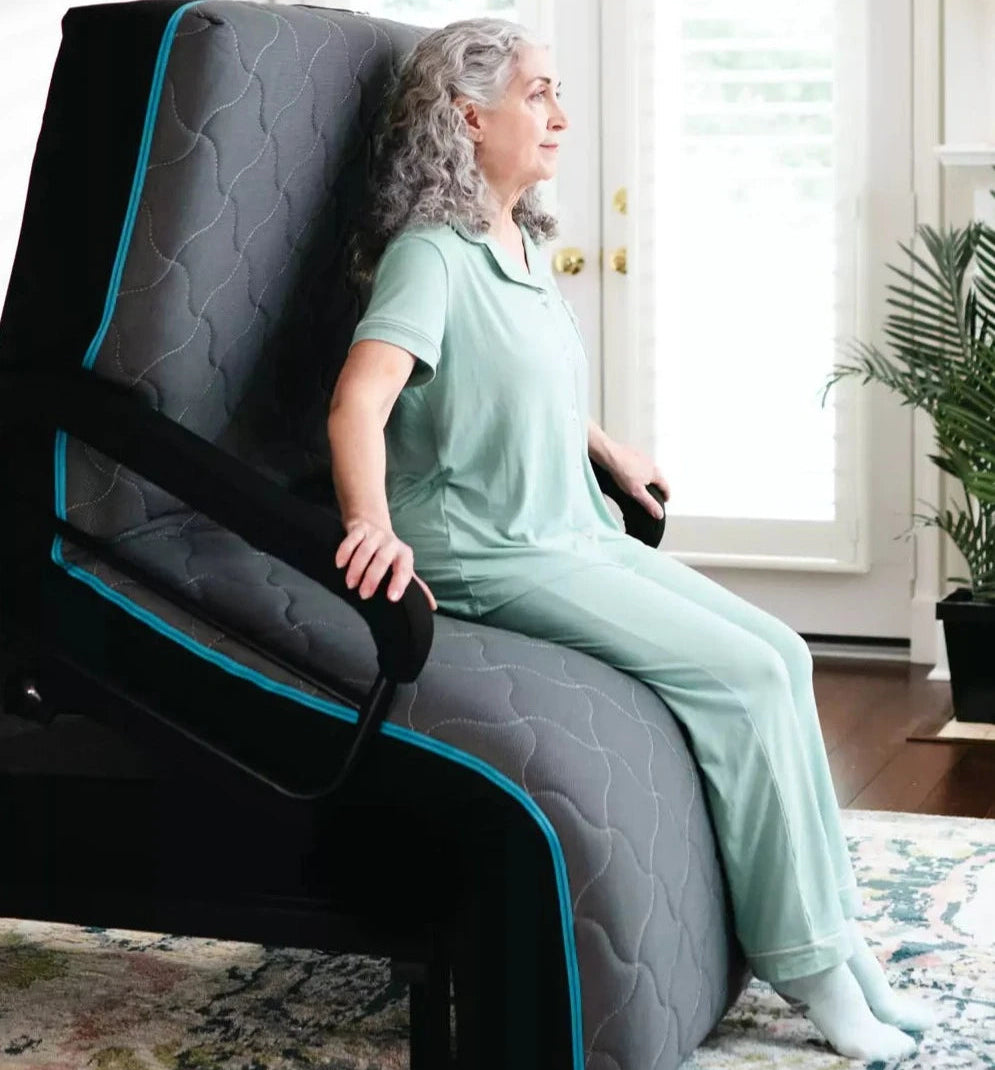
Does Medicare Cover Lift Chairs? What the Seat Lift Rules Say
Quick answer: Medicare may help pay for the seat lift mechanism, the part that raises you, but not the chair itself. Under the CMS coverage rule, you must have severe hip or knee arthritis or a severe neuromuscular disease, be completely unable to stand from any chair at home, and be able to walk once you are up.
The rule is narrow. Someone who struggles to get out of a low chair may not qualify, and the rules say exactly that. This guide walks through the federal coverage documents for seat lifts so you know what to ask your doctor and the supplier before you spend money.
What Medicare pays for: the lift, not the chair
The CMS policy article for seat lift mechanisms (A52518) says seat lift mechanisms are covered under the durable medical equipment (DME) benefit, as long as the medical criteria in the related coverage rule are met. An electric lift is billed as code E0627 and a manual lift as E0629. (CMS, Seat Lift Mechanisms Policy Article A52518)
When the lift comes built into a chair as one unit, the policy article says the supplier may bill the lift mechanism under E0627 or E0629 and bill the chair under A9270. CMS uses A9270 for a "noncovered item or service." (CMS, Respiratory Assist Devices Policy Article A52517 (used here only for the meaning of code A9270)) The national coverage rule adds a second limit: for a unit that has a recliner feature along with the seat lift, payment is limited to the amount for a seat lift without that feature. (CMS, National Coverage Determination 280.4, Seat Lift)
| Part or type | How the CMS documents treat it |
|---|---|
| Electric seat lift mechanism (E0627) | Covered as DME if the medical criteria are met |
| Manual seat lift mechanism (E0629) | Covered as DME if the medical criteria are met |
| The chair itself, when the lift is built in | Not paid by Medicare; may be billed as A9270, a non-covered item |
| Recliner feature on a lift chair | Payment limited to the amount for a seat lift without it |
| Spring-release lift with a sudden, catapult-like motion | Excluded from coverage |
| Toilet seat lift (E0172) | Non-covered |
The national rule also says covered seat lifts must operate smoothly, be controlled by the patient, and help the person stand up and sit down without other assistance. The spring-release type, which jolts the person up with a sudden, catapult-like motion, is excluded.
Who qualifies: the four CMS criteria
The local coverage determination for seat lift mechanisms (LCD L33801, revision effective July 2, 2023) says a seat lift mechanism is covered only if all of these are true: (CMS, LCD L33801 Seat Lift Mechanisms)
- The person has severe arthritis of the hip or knee, or a severe neuromuscular disease.
- The seat lift is part of the treating practitioner's course of treatment and is prescribed to bring improvement, or to stop or slow decline in the person's condition.
- The person is completely unable to stand up from a regular armchair or any chair in their home.
- Once standing, the person is able to walk.
In our view, criterion 3 is the easiest one to misread. The LCD states that having difficulty, or even being unable, to get up from a chair, particularly a low chair, is not enough. It adds that almost everyone who can walk can get out of an ordinary chair if the seat height is right and the chair has arms.
The rule also puts work on the doctor's side. The practitioner who orders the lift must be the treating or consulting practitioner for the condition behind the need. Their records must show that other treatments, such as medication or physical therapy, were tried and did not make it possible to get from a chair to standing.
What the doctor and supplier need
The LCD says a Standard Written Order must reach the supplier before a claim is submitted, or the claim will be denied. The policy article says suppliers no longer need to send a Certificate of Medical Necessity with claims for services on or after January 1, 2023.
The seller matters as much as the paperwork. The Medicare booklet on durable medical equipment says Medicare only covers DME from a supplier enrolled in Medicare, meaning one that has been approved and has a Medicare supplier number. If the supplier does not have that number, Medicare will not pay your claim, even if the supplier is a large chain or department store. (Medicare Coverage of Durable Medical Equipment & Other Devices, CMS Product No. 11045)
The booklet suggests these questions for a supplier:
- Are you a Medicare-enrolled supplier?
- Do you accept assignment?
- If you do not accept assignment, will you consider assignment in my case?
- If you will not consider assignment, what is your non-assignment charge?
- Will you bill Medicare for me?
The booklet points to Medicare.gov/medical-equipment-suppliers to find a supplier in your area.
What you pay
For DME in general, the booklet says you pay 20% of the Medicare-approved amount after you pay the Part B deductible for the year. The booklet defines the Medicare-approved amount as whichever is lower: the supplier's actual charge or Medicare's set fee for the item. If the supplier accepts assignment, it agrees to charge you only the deductible and coinsurance for the Medicare-approved amount. The booklet also says a Medigap policy may help cover some of these costs.
Because Medicare pays only toward the lift mechanism, and the chair can be billed as a non-covered item, plan on paying for the chair yourself. In our view, ask the supplier for a written price that splits the lift mechanism from the chair and any recliner or upholstery upgrades. That split shows what Medicare can pay toward and what it cannot.
If a supplier expects Medicare to deny the lift as not medically necessary, the policy article says it must mark the claim to show whether it got a signed Advance Beneficiary Notice (ABN) from you. Read any ABN before you sign it.
Lift chair or lift bed?
A seat lift fixes one problem, which is standing up from a chair. It does nothing for getting out of bed at night. Our guide on whether lift chairs are good or bad for the elderly covers the trade-offs, and a comfortable alternative to sleeping in a recliner looks at people who end up sleeping in the chair. For the bedroom, see devices that help the elderly get out of bed.
EzLift sells lift beds for home use. EzLift is not a Medicare-enrolled supplier. EzLift beds are not billed to Medicare, Medicaid or insurance. For other ways families pay for a bed, see how to pay for a lift bed without Medicare. For related coverage rules, see does Medicare cover beds and does Medicare cover patient lifts.
Steps to take before you order
- Talk to the treating doctor. Ask whether the person meets all four LCD criteria, including being completely unable to stand from any chair at home.
- Check the records. The doctor's notes need to show that treatments such as medication or physical therapy were tried first.
- Find an enrolled supplier. Use the booklet's questions above, and confirm the supplier has a Medicare supplier number.
- Get the split price in writing. Lift mechanism on one line, chair and extras on another.
- If you have Medicare Advantage, call your plan first. Suppliers and costs depend on the plan.
FAQ
Does Medicare pay for the whole lift chair?
No. The CMS policy article for seat lift mechanisms says that when the lift comes built into a chair, the supplier may bill the lift mechanism under its own code and bill the chair under A9270, the code CMS uses for a non-covered item or service. The national coverage rule also limits payment for a unit with a recliner feature to the amount for a seat lift without that feature.
What conditions qualify for a lift chair under Medicare?
The CMS local coverage rule (LCD L33801) lists severe arthritis of the hip or knee or a severe neuromuscular disease. The person must also be completely unable to stand up from a regular armchair or any chair at home, must be able to walk once standing, and the lift must be part of the treating practitioner's course of treatment.
Can I buy a lift chair at a furniture store and have Medicare pay?
Only if the seller is a Medicare-enrolled supplier. The official Medicare booklet on durable medical equipment says that if a supplier does not have a Medicare supplier number, Medicare will not pay the claim, even if the supplier is a large chain or department store. Ask before you buy.
Does Medicare cover a toilet seat lift?
No. The CMS policy article says a seat lift mechanism placed over or on top of a toilet, of any type (code E0172), is non-covered.
Does Medicare Advantage cover lift chairs?
The Medicare booklet says Medicare Advantage Plans must cover the same medically necessary categories of durable medical equipment as Original Medicare, but your suppliers and costs depend on your plan. Contact your plan before you order, and check its Evidence of Coverage document for cost-sharing.
Sources
- CMS, National Coverage Determination (NCD) 280.4, Seat Lift: https://www.cms.gov/medicare-coverage-database/view/ncd.aspx?NCDId=221
- CMS, Local Coverage Determination L33801, Seat Lift Mechanisms (revision effective 07/02/2023): https://www.cms.gov/medicare-coverage-database/view/lcd.aspx?lcdid=33801
- CMS, Seat Lift Mechanisms Policy Article A52518 (revision effective 07/02/2023): https://www.cms.gov/medicare-coverage-database/view/article.aspx?articleId=52518
- CMS, Respiratory Assist Devices Policy Article A52517 (definition of code A9270): https://www.cms.gov/medicare-coverage-database/view/article.aspx?articleId=52517
- Centers for Medicare & Medicaid Services, Medicare Coverage of Durable Medical Equipment & Other Devices (CMS Product No. 11045, 2/2025): https://www.medicare.gov/publications/11045-medicare-coverage-of-dme-and-other-devices.pdf
Written by the EzLift Team, EzLift's organizational authorship team. Last reviewed November 18, 2026. This guide summarizes CMS coverage documents for seat lift mechanisms and the official Medicare booklet on durable medical equipment. It is not medical, legal or insurance advice. Medicare rules can change. Confirm coverage with your doctor, the supplier, your plan or 1-800-MEDICARE (1-800-633-4227) before you buy. EzLift is not a Medicare-enrolled supplier. EzLift beds are not billed to Medicare, Medicaid or insurance.